

Cross-Language Consistency
Same seed = same data across all languages. No more integration test mismatches. Learn more →
Your frontend expects Alice. Your backend returns Bob.
Different faker libraries = Different realities.
Pseudata solves this by making mock data generation a standardized algorithm—not a language-specific implementation.
📖 Read the full story: Why faker.js and Faker Don’t Agree
Cross-Language Consistency
Same seed = same data across all languages. No more integration test mismatches. Learn more →
Infinite Scale
instant access to billions of records with zero memory overhead. Learn more →
Stateless Relations
Create deterministic relationships without a database. Navigate entities in time. Learn more →
Smart Locale Loading
Minimal default, scale globally. Load only the specific regions and data you need. Learn more →
Pseudata is the only faker library that guarantees both cross-language consistency and infinite scale.
Different data across languages
# Python (Faker)Faker.seed(42)fake.name() # → "Brett Davis"// TypeScript (faker.js)faker.seed(42);faker.person.fullName(); // → "Miss Dora Kiehn"Sequential access only
# To get item 1,000,000, must iterate - O(n)faker.seed(42)for i in range(1_000_000): name = faker.name()Identical data across all languages
# Pythonusers = UserArray(42)user = users.at(0)print(user.name) # → "John Smith"// TypeScriptconst users = new UserArray(42);const user = users.at(0);console.log(user.name); // → "John Smith"Direct access to any index -
# Jump directly to the billionth recordusers = UserArray(42)user = users.at(1_000_000_000) # InstantCross-Language Consistency enables reliable integration testing across polyglot systems. When your Go backend and TypeScript frontend both generate User[1000] with seed 42, you get the same test data—eliminating the integration test mismatches that plague microservices architectures.
Direct Access unlocks scenarios impossible with traditional fakers:
User[1000] with seed 42 = Always the same across every language:
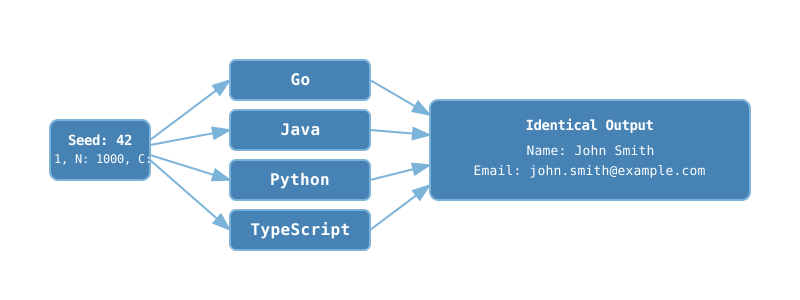
package mainimport "github.com/pseudata/pseudata"
users := pseudata.NewUserArray(42)user := users.At(1000)fmt.Println(user.Name)  // → "John Smith"fmt.Println(user.Email) // → "john.smith@example.com"
import dev.pseudata.UserArray;
UserArray users = new UserArray(42);User user = users.at(1000);System.out.println(user.getName()); // → "John Smith"System.out.println(user.getEmail()); // → "john.smith@example.com"from pseudata import UserArray
users = UserArray(42)user = users.at(1000)print(user.name) # → "John Smith"print(user.email) # → "john.smith@example.com"import { UserArray } from "@pseudata/core";
const users = new UserArray(42);const user = users.at(1000);console.log(user.name); // → "John Smith"console.log(user.email); // → "john.smith@example.com"Navigate complex data graphs in time without requiring a database.
Traditional mock data is “flat”—users and groups have no inherent connection unless you manually link them. Pseudo links use a bit-coordinate system to bake relationships directly into the IDs themselves.
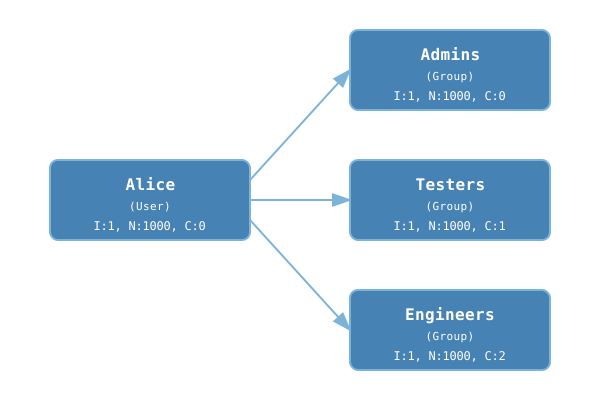
Relational data that exists mathematically
By treating a 40-bit index as a coordinate (island, neighborhood, and connector), you can instantly calculate the ID of a related entity.
import "github.com/pseudata/pseudata"
users := pseudata.NewUserArray(42)groups := pseudata.NewGroupArray(42)link := pseudata.NewPseudoLink(17, 3)
// Alice in neighborhood 1000aliceIdx := link.Encode(1, 1000, 0)alice := users.At(aliceIdx)
// Find Alice's group (same coordinates, different entity type)groupIdx := link.Resolve(aliceIdx, 0)group := groups.At(groupIdx)
import dev.pseudata.UserArray;import dev.pseudata.GroupArray;import dev.pseudata.PseudoLink;
UserArray users = new UserArray(42);GroupArray groups = new GroupArray(42);PseudoLink link = new PseudoLink(17, 3);
long aliceIdx = link.encode(1, 1000, 0);User alice = users.at(aliceIdx);
long groupIdx = link.resolve(aliceIdx, 0);Group group = groups.at(groupIdx);from pseudata import UserArray, GroupArray, PseudoLink
users = UserArray(42)groups = GroupArray(42)link = PseudoLink(17, 3)
alice_idx = link.encode(1, 1000, 0)alice = users.at(alice_idx)
group_idx = link.resolve(alice_idx, 0)group = groups.at(group_idx)import { UserArray, GroupArray, PseudoLink } from '@pseudata/core';
const users = new UserArray(42n);const groups = new GroupArray(42n);const link = new PseudoLink(17, 3);
const aliceIdx = link.encode(1, 1000, 0);const alice = users.at(aliceIdx);
const groupIdx = link.resolve(aliceIdx, 0);const group = groups.at(groupIdx);Learn more about Stateless Relations →
Traditional faker libraries load all locale data at once or require complex configuration. Pseudata uses a compositional architecture that eliminates duplication and enables precise control.
The diagram below shows how bundle modules are composed from locale modules, which are themselves composed from atomic modules (general, country, language). Box labels are relative import paths from @pseudata/core/resources/ (omitted for readability).
Composition uses shallow copies of resource data—no duplication, just references. This makes creating new bundles extremely cheap: adding a region or custom locale combination has minimal overhead.
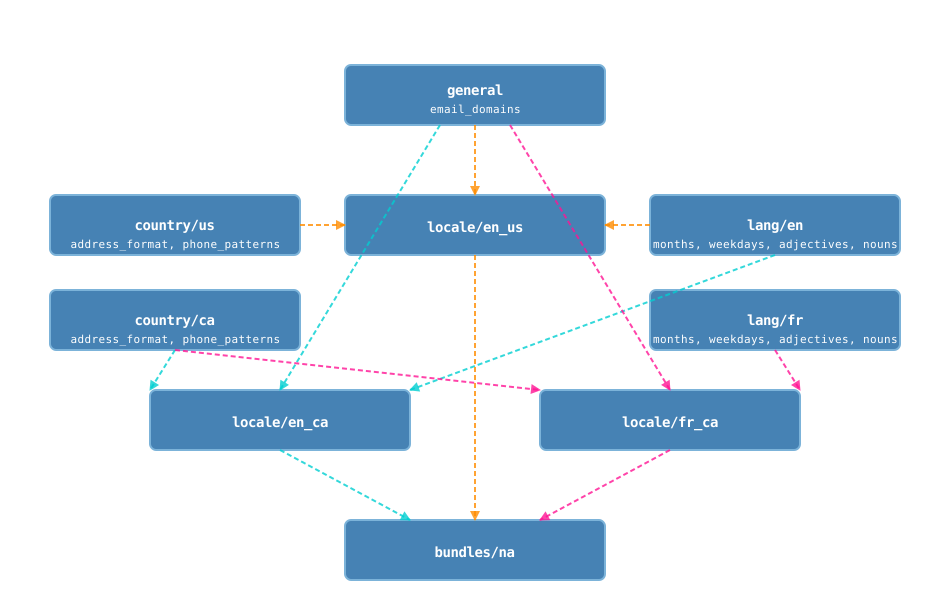
Data is organized into four intelligent layers:
Canadian Example: Both en_CA and fr_CA share the same country data (Canadian address formats, phone patterns) but use different language data. English months are defined once in en/ and reused by both en_US and en_CA—zero duplication.
Choose bundles that match your needs:
By default, only US locale loads. Import regional bundles as you expand.
Modern build tools automatically tree-shake unused bundles. You only ship what you use.
By default, Pseudata loads only the US bundle (en_US locale). This means you can start using Pseudata immediately without any configuration:
import "github.com/pseudata/pseudata"
users := pseudata.NewUserArray(42)
import dev.pseudata.UserArray;
UserArray users = new UserArray(42);from pseudata import UserArray
users = UserArray(42)import { UserArray } from '@pseudata/core';
const users = new UserArray(42n);Import a bundle and pass it via options to use locales from that region.
import (    "github.com/pseudata/pseudata"    "github.com/pseudata/pseudata/resources/bundles/na")
users := pseudata.NewUserArray(42, pseudata.WithResources(na.Resources))
import dev.pseudata.UserArray;import dev.pseudata.resources.bundles.na.Resources;
UserArray users = new UserArray(42, Resources.INSTANCE);from pseudata import UserArrayfrom pseudata.resources.bundles.na import resources_na
users = UserArray(42, resources=resources_na)import { UserArray } from '@pseudata/core';import { Resources } from '@pseudata/core/resources/bundles/na';
const users = new UserArray(42n, { resources: Resources });© 2025 Pseudata Project. Open Source under Apache License 2.0. · RSS Feed